Other › Fit for human consumption
1001.99.12 — Wheat grain without extreme outer layer
Hạt lúa mì đã bỏ lớp vỏ ngoài cùng (SEN)
Unit: kg (kg)
Hồ sơ mã HS — hscodevn.com/hs/10019912 · in ngày 15/9/2026 · chỉ mang tính tham khảo, đối chiếu văn bản pháp lý hiện hành
HS code 10019912 covers wheat grain without extreme outer layer under heading 1001 (wheat and meslin), Chapter 10. The MFN import duty is 0%; the lowest FTA rate is 0% under ASEAN - China (ACFTA) (C/O form E required). VAT: */5/8/10. Unit of quantity: kg.
MFN import duty
0%
Lowest FTA
0%
ASEAN - China (ACFTA)
VAT
*/5/8/10
8% under the current reduction · 10% standard · 5% specific groups · * some cases not subject
Excise / Env. tax
—
Not subject
Import duty comparison across FTA schedules
Full table with legal documents & effective dates
| Tax / Schedule | Rate | Document | Effective |
|---|---|---|---|
| Preferential import duty (MFN) | 0% | 26/2023/NĐ-CP | 15/07/2023 |
| Ordinary import duty | 5% | 15/2023/QĐ-TTg | 15/07/2023 |
| ASEAN (ATIGA)(2026) | 0% | 126/2022/NĐ-CP | 30/12/2022 |
| ASEAN - China (ACFTA) | 0% | 118/2022/NĐ-CP | 30/12/2022 |
| ASEAN - Japan (AJCEP)(01/04/2026 - 31/3/2027) | 0% | 120/2022/NĐ-CP | 30/12/2022 |
| Vietnam - Japan (VJEPA)(1/4/2026 - 31/3/2027) | 0% | 124/2022/NĐ-CP | 30/12/2022 |
| ASEAN - Korea (AKFTA) | 0% | 119/2022/NĐ-CP | 30/12/2022 |
| ASEAN - Australia/New Zealand (AANZFTA) | 0% | 121/2022/NĐ-CP | 30/12/2022 |
| ASEAN - India (AIFTA)(01/01/2026 - 31/12/2026) | 0% | 122/2022/NĐ-CP | 30/12/2022 |
| Vietnam - Korea (VKFTA)(2026) | 0% | 125/2022/NĐ-CP | 30/12/2022 |
| Vietnam - Chile (VCFTA)(2026) | 0% | 112/2022/NĐ-CP | 30/12/2022 |
| Vietnam - Eurasian Economic Union (VN-EAEU)(2026) | 0% | 113/2022/NĐ-CP | 30/12/2022 |
| CPTPP Agreement(2026) | 0% | 115/2022/NĐ-CP | 30/12/2022 |
| ASEAN - Hong Kong (AHKFTA)(2026) | 0% | 123/2022/NĐ-CP | 30/12/2022 |
| Vietnam - EU (EVFTA)(2026) | 0% | 116/2022/NĐ-CP | 30/12/2022 |
| Vietnam - UK (UKVFTA)(2026) | 0% | 117/2022/NĐ-CP | 30/12/2022 |
| Vietnam - Laos | 0% | 206/2025/NĐ-CP | 15/07/2025 |
| Vietnam - Israel (VIFTA)(2026) | 0% | 131/2024/NĐ-CP | 15/10/2024 |
| RCEP - Group A (ASEAN)(2026) | 0% | 129/2022/NĐ-CP | 30/12/2022 |
| RCEP - Group B (China)(2026) | 0% | 129/2022/NĐ-CP | 30/12/2022 |
| RCEP - Group C (Korea)(2026) | 0% | 129/2022/NĐ-CP | 30/12/2022 |
| RCEP - Group D (Japan)(2026) | 0% | 129/2022/NĐ-CP | 30/12/2022 |
| RCEP - Group E (Australia)(2026) | 0% | 129/2022/NĐ-CP | 30/12/2022 |
| RCEP - Group F (New Zealand)(2026) | 0% | 129/2022/NĐ-CP | 30/12/2022 |
FTA schedules are cut annually: the rate shown applies to the period in brackets, per the decree's appendix.
VAT · Excise tax · Environmental protection tax
| Tax / Schedule | Rate | Document | Effective |
|---|---|---|---|
| Value added tax (VAT) | */5/8/10 | 181/2025/NĐ-CP | 01/07/2025 |
Rules of origin by FTA
To claim an FTA rate the goods must meet the origin criterion below AND carry a valid C/O — the right HS code alone is not enough. Step-by-step self-check →
- - Other:
WO
WO
WO
Source: Circular No. 44/2025/TT-BCT · annex uses HS 2022 while this site uses AHTN 2022 — check headings that changed between versions
- - Other:
WO
WO
WO
Source: Circular No. 21/2019/TT-BCT · annex uses HS 2012 while this site uses AHTN 2022 — check headings that changed between versions
Cereals
CC
CC
CC
Source: Circular No. 37/2022/TT-BCT · annex uses HS 2017 while this site uses AHTN 2022 — check headings that changed between versions
Cereals
WO
WO
WO
Source: Circular No. 49/2025/TT-BCT · annex uses HS 2022 while this site uses AHTN 2022 — check headings that changed between versions
- - Other:
WO
WO
WO
Source: Circular No. 03/2023/TT-BCT · annex uses HS 2022 while this site uses AHTN 2022 — check headings that changed between versions
Wheat and meslin
CC
CC
CC
Source: Circular No. 03/2019/TT-BCT · annex uses HS 2012 while this site uses AHTN 2022 — check headings that changed between versions
Cereals
Materials of Chapter 10 must be wholly obtained.
Nguyên liệu thuộc Chương 10 có xuất xứ thuần túy.
WO
Source: Circular No. 14/2026/TT-BCT
Cereals
WO
WO
WO
Source: Circular No. 32/2022/TT-BCT · annex uses HS 2022 while this site uses AHTN 2022 — check headings that changed between versions
Cereals
Materials of Chapter 10 must be wholly obtained.
Nguyên liệu thuộc Chương 10 có xuất xứ thuần túy.
WO
Source: Circular No. 02/2021/TT-BCT
- - Other:
WO
WO
WO
Source: Circular No. 09/2022/TT-BCT · annex uses HS 2017 while this site uses AHTN 2022 — check headings that changed between versions
- - Other:
CC
CC
CC
Source: Circular No. 01/2024/TT-BCT · annex uses HS 2022 while this site uses AHTN 2022 — check headings that changed between versions
Cereals
Toàn bộ nguyên liệu thuộc Chương 10 có xuất xứ thuần túy
WO
Source: Circular No. 24/2026/TT-BCT · annex uses HS 2022 while this site uses AHTN 2022 — check headings that changed between versions
Agreements with no rule specific to this code
This code carries a preferential rate under the agreements below but has no line of its own in the product-specific rules annex. The goods must still meet an origin requirement.
The agreement sets a general rule for codes outside the annex:
1. Products referred to in Clause 2, Article 2 are considered originating if:
a) The AIFTA content is not less than thirty-five per cent (35%) of the FOB value; and
b) The non-originating materials used in the production of that product have undergone a change in tariff classification at the six (6)-digit level (CTSH) of the Harmonized System.
provided that the last production process is carried out in the territory of the exporting Member State.
CTSH
Source: Circular No. 15/2010/TT-BCT · Article 4(1) of Appendix 1
The agreement sets a general rule for codes outside the annex:
1. General origin criterion
a) Goods specified in Clause 2 of Article 2 shall be considered as originating in the Member State where the working or processing of those goods has taken place if:
- The goods have a regional value content (hereinafter referred to as the “Viet Nam - Laos value content” or the “regional value content (LVC)”) of not less than forty percent (40%), calculated in accordance with the formula provided in Article 5; or
- All non-originating materials used in the production of those goods have undergone a change in tariff classification (hereinafter referred to as “CTC”) at the four (4)-digit level (meaning a change of heading) of the Harmonized System.
b) Each Member State shall allow the exporter of the goods to decide to use either of the two criteria “LVC of not less than forty percent (40%)” or “change in tariff classification at the four (04)-digit level” referred to at point a of Clause 1 in order to determine the origin of the goods.
CTCLVC
Source: Circular No. 04/2010/TT-BCT · Article 4(1) of Appendix 1
Criteria are translated for reference; the Vietnamese wording quoted underneath is the binding text.
Commodity policy for this HS code
Unofficial English rendering of the Vietnamese source; the document numbers link to the full text.
Managing authority: Ministry of Agriculture and Environment
- Plant quarantine (01/2024/TT-BNNPTNT M9)Quarantine· Ministry of Agriculture and Environment
Related documents (full text)
Supplementary Explanatory Notes (SEN, ASEAN 2022)
Product description1001.99.11 1001.99.12 1001.99.19WHEAT AND MESLIN, FIT FOR HUMAN CONSUMPTION
LÚA MÌ VÀ MESLIN THÍCH HỢP SỬ DỤNG CHO NGƯỜI
Wheat or Meslin fit for human consumption are those clean, healthy and accepted by competent authorities as fit for human consumption. Such grains are used for food production, such as flour.
(Source: Philippines)
Tiếng Việt
Lúa mì hoặc meslin phù hợp sử dụng cho người là loại sạch, tốt cho sức khoẻ và được chứng nhận bởi các cơ quan có thẩm quyền là phù hợp sử dụng cho người. Những hạt này được sử dụng để sản xuất thực phẩm, chẳng hạn như bột mì.
(Nguồn: Phi-lip-pin)
Supplementary Explanatory Notes (SEN, ASEAN 2022)
Product description1001.99.12WHEAT GRAIN, WITHOUT THE EXTREME OUTER LAYER
HẠT LÚA MÌ ĐÃ BỎ LỚP VỎ NGOÀI CÙNG
Wheat grain's hull (the extreme outer layer) is formed in such a way that it remains attached to the cob when the grain is detached from the cob. As a result, without threshing or other human intervention for hulling, the wheat grain in natural unworked status does not have a hull. Therefore, "unprocessed wheat grain without hull" should remain in Heading 10.01, because the Legal Note 1 (B) to Chapter 10 does not apply as the hull is removed naturally, and not due to any human intervention or other working.
Cấu tạo của hạt
Anatomy of a Grain
Tiếng Việt
Vỏ hạt lúa mì (lớp ngoài cùng) được hình thành theo cách mà nó vẫn dính vào lõi khi hạt tách ra khỏi lõi. Kết quả là, không cần đập hoặc sự can thiệp của con người để bóc vỏ, hạt lúa mì ở trạng thái tự nhiên chưa qua xử lý sẽ không có vỏ. Do đó, "hạt lúa mì chưa qua chế biến không có vỏ" nên được giữ nguyên trong Nhóm 10.01, vì Chú giải pháp lý 1 (B) của Chương 10 không áp dụng vì vỏ ngoài được bỏ ra một cách tự nhiên và không do bất kỳ sự can thiệp nào của con người hoặc các hoạt động khác.
Cấu tạo của hạt
Anatomy of a Grain
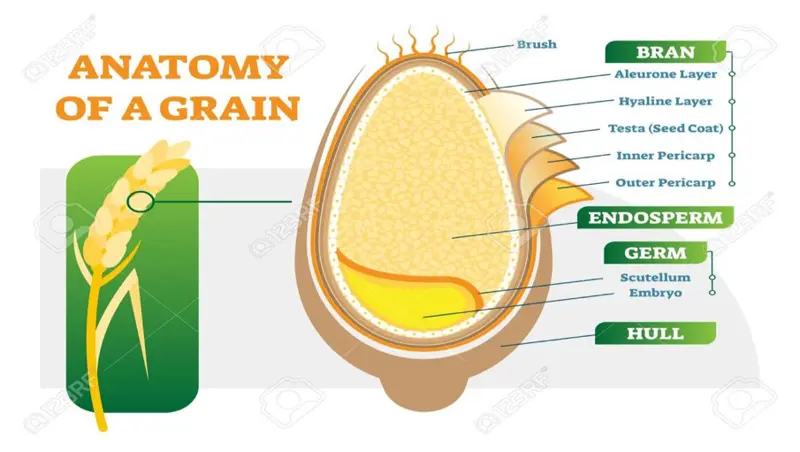
Notes for Section II — VEGETABLE PRODUCTS
1. In this Section the term “pellets” means products which have been agglomerated either directly by compression or by the addition of a binder in a proportion not exceeding 3% by weight.
Notes for Chapter 10 — Cereals
Notes
1. (A) The products specified in the headings of this Chapter are to be classified in those headings only if grains are present, whether or not in the ear or on the stalk.
(B) The Chapter does not cover grains which have been hulled or otherwise worked. However, rice, husked, milled, polished, glazed, parboiled or broken remains classified in heading 10.06. Similarly, quinoa from which the pericarp has been wholly or partly removed in order to separate the saponin, but which has not undergone any other processes, remains classified in heading 10.08.
2. Heading 10.05 does not cover sweet corn (Chapter 7).
Subheading Note
1. The term “durum wheat” means wheat of the Triticum durum species and the hybrids derived from the inter-specific crossing of Triticum durum which have the same number (28) of chromosomes as that species.
Vietnam trade in subheading 1001.99
Figures cover the whole 6-digit subheading 1001.99, not code 10019912 alone — UN Comtrade only publishes to 6 digits. Latest year available for Vietnam is 2023.
Imports
- 20211.4 bn USD
- 20221.5 bn USD
- 20231.6 bn USD
Top partners 2023
- Australia922 mn USD
- Ukraine167 mn USD
- USA142 mn USD
- Canada109 mn USD
- Brazil96 mn USD
- Russian Federation56 mn USD
- Romania26 mn USD
- Bulgaria21 mn USD
Exports
- 202113 mn USD
- 202213 mn USD
- 202325 mn USD
Top partners 2023
- Cambodia24 mn USD
- Lao People's Dem. Rep.623,145 USD
2025: as reported by partner countries
Vietnam has not filed 2025 yet, so this is rebuilt from what its 16 largest trading partners reported about trade with Vietnam (85% of Vietnam's trade). Not the same measure as the figures above — compare it only with the 2023 row beside it.
| Flow | 2023 | 2025 | Change |
|---|---|---|---|
| Exports | 283 USD | 1 mn USD | +408498% |
| Imports | 1.2 bn USD | 962 mn USD | -19% |
- Exports 2023: partners reported 283 USD where Vietnam reported 25 mn USD — 0.00× on this measure.
- Imports 2023: partners reported 1.2 bn USD where Vietnam reported 1.6 bn USD — 0.76× on this measure.
The gap is not a rounding difference: goods re-exported through Hong Kong or Singapore, a different heading chosen by the importing customs, and origin-based versus destination-based attribution all pull the two measures apart. Use the year-on-year change, not the level.
Source: UN Comtrade (preview API) — reported by Vietnam. Partner totals are as reported and may differ from partner-country statistics.
Corresponding US tariff lines
Six digits are identical worldwide under the HS Convention, so 1001.99 is the same subheading in both schedules. What differs is how each country splits it: below are the 14 US lines under 1001.99.
| US HTS code | Description | General duty |
|---|---|---|
| 1001.99.00.05 | Other › Other › Canadian western extra strong hard red spring (CWES/HRS) wheat(kg) | 0.35¢/kg |
| 1001.99.00.07 | Other › Other › Other › Certified organic › Red spring wheat(kg) | 0.35¢/kg |
| 1001.99.00.09 | Other › Other › Other › Certified organic › Other(kg) | 0.35¢/kg |
| 1001.99.00.10 | Other › Other › Other › Other › Red spring wheat › Grade 1 › Having a specified protein content not exceeding 12.9% by weight(kg) | 0.35¢/kg |
| 1001.99.00.17 | Other › Other › Other › Other › Red spring wheat › Grade 1 › Having a specified protein content exceeding 12.9% but not exceeding 13.9% by weight.(kg) | 0.35¢/kg |
| 1001.99.00.18 | Other › Other › Other › Other › Red spring wheat › Grade 1 › Having a specified protein content exceeding 13.9% by weight(kg) | 0.35¢/kg |
| 1001.99.00.27 | Other › Other › Other › Other › Red spring wheat › Grade 2 › Having a specified protein content not exceeding 12.9% by weight(kg) | 0.35¢/kg |
| 1001.99.00.30 | Other › Other › Other › Other › Red spring wheat › Grade 2 › Having a specified protein content exceeding 12.9% but not exceeding 13.9% by weight.(kg) | 0.35¢/kg |
Additional Chapter 99 duties apply to goods of Vietnam
- 9903.02.69 +20% — The duty provided in the applicable subheading + 20%
- 9903.05.84 +12.5% — The duty provided in the applicable subheading + 12.5%
These are added to the General duty above, not in place of it. Whether a given article falls inside their scope — and the exclusion lists — is set out in the U.S. notes to Chapter 99, which are prose and not machine-readable, so this site does not assign them per code. Check the official schedule before quoting a landed cost.
Already terminated: 9903.01.72 +46%
Selling to a US buyer? Screen the parties first — buyer, L/C bank and forwarder against the US restricted lists; a listed party can get the shipment held.
The General column is the rate for Vietnam: the Special column lists US preference programmes (GSP, USMCA, KORUS…) and Vietnam is in none of them. Source: USITC Harmonized Tariff Schedule of the United States — 2026 HTS Revision 18. For reference only — classification on import is decided by US Customs, and anti-dumping, countervailing and Section 232/301 measures are not covered here.
Corresponding Japanese tariff lines
1001.99 is the same subheading in both schedules (six digits are identical worldwide under the HS Convention). Vietnamese goods can enter Japan under four parallel preference routes — the columns below — and the exporter picks whichever C/O gives the better rate.
| Line | Description | MFN | VJEPA | AJCEP | CPTPP | RCEP |
|---|---|---|---|---|---|---|
| 1001.99 | Other | (65 yen/kg) | — | — | — | — |
MFN is the lowest of the schedule's General/Temporary/WTO columns (hover to see all three). The preference columns require the matching certificate of origin; an em dash means that agreement gives no preference for the line. Source: Japan's Tariff Schedule, Japan Customs (as of August 8, 2026). For reference only — classification on import is decided by Japan Customs.
Codes at the same level under “Fit for human consumption:”
Check neighbouring codes to make sure the classification fits best.
Data updated: 11/08/2026 · Found wrong or missing data? Report a data error