Other › Other, in primary forms
4001.29.94 — Deproteinised Natural Rubber (DPNR)
Cao su tự nhiên đã khử protein (DPNR) (SEN)
Unit: kg (kg)
Hồ sơ mã HS — hscodevn.com/hs/40012994 · in ngày 15/9/2026 · chỉ mang tính tham khảo, đối chiếu văn bản pháp lý hiện hành
HS code 40012994 covers deproteinised natural rubber (dpnr) under heading 4001 (natural rubber, balata, gutta-percha, guayule, chicle and similar natural gums, in primary forms or in plates, sheets or strip), Chapter 40. The MFN import duty is 3%; the lowest FTA rate is 0% under ASEAN - China (ACFTA) (C/O form E required). VAT: */5/8/10. Unit of quantity: kg.
MFN import duty
3%
Lowest FTA
0%
excl. CN
ASEAN - China (ACFTA)
VAT
*/5/8/10
8% under the current reduction · 10% standard · 5% specific groups · * some cases not subject
Excise / Env. tax
—
Not subject
Distinguish from heading:4002Synthetic rubber and factice…
Import duty comparison across FTA schedules
Full table with legal documents & effective dates
| Tax / Schedule | Rate | Document | Effective |
|---|---|---|---|
| Preferential import duty (MFN) | 3% | 26/2023/NĐ-CP | 15/07/2023 |
| Ordinary import duty | 4.5% | 15/2023/QĐ-TTg | 15/07/2023 |
| ASEAN (ATIGA)(2026) | 0% | 126/2022/NĐ-CP | 30/12/2022 |
| ASEAN - China (ACFTA) | 0%excl. CN | 118/2022/NĐ-CP | 30/12/2022 |
| ASEAN - Japan (AJCEP)(01/04/2026 - 31/3/2027) | 0% | 120/2022/NĐ-CP | 30/12/2022 |
| Vietnam - Japan (VJEPA)(1/4/2026 - 31/3/2027) | 0% | 124/2022/NĐ-CP | 30/12/2022 |
| ASEAN - Korea (AKFTA) | 0% | 119/2022/NĐ-CP | 30/12/2022 |
| ASEAN - Australia/New Zealand (AANZFTA) | 0% | 121/2022/NĐ-CP | 30/12/2022 |
| ASEAN - India (AIFTA)(01/01/2026 - 31/12/2026) | 0% | 122/2022/NĐ-CP | 30/12/2022 |
| Vietnam - Korea (VKFTA)(2026) | 0% | 125/2022/NĐ-CP | 30/12/2022 |
| Vietnam - Chile (VCFTA)(2026) | 0% | 112/2022/NĐ-CP | 30/12/2022 |
| Vietnam - Eurasian Economic Union (VN-EAEU)(2026) | 0% | 113/2022/NĐ-CP | 30/12/2022 |
| CPTPP Agreement(2026) | 0% | 115/2022/NĐ-CP | 30/12/2022 |
| ASEAN - Hong Kong (AHKFTA)(2026) | * | 123/2022/NĐ-CP | 30/12/2022 |
| Vietnam - EU (EVFTA)(2026) | 0% | 116/2022/NĐ-CP | 30/12/2022 |
| Vietnam - UK (UKVFTA)(2026) | 0% | 117/2022/NĐ-CP | 30/12/2022 |
| Vietnam - Laos | 0% | 206/2025/NĐ-CP | 15/07/2025 |
| Vietnam - Israel (VIFTA)(2026) | 1,7% | 131/2024/NĐ-CP | 15/10/2024 |
| RCEP - Group A (ASEAN)(2026) | 2% | 129/2022/NĐ-CP | 30/12/2022 |
| RCEP - Group B (China)(2026) | 2% | 129/2022/NĐ-CP | 30/12/2022 |
| RCEP - Group C (Korea)(2026) | * | 129/2022/NĐ-CP | 30/12/2022 |
| RCEP - Group D (Japan)(2026) | 2,1% | 129/2022/NĐ-CP | 30/12/2022 |
| RCEP - Group E (Australia)(2026) | 2% | 129/2022/NĐ-CP | 30/12/2022 |
| RCEP - Group F (New Zealand)(2026) | 2% | 129/2022/NĐ-CP | 30/12/2022 |
FTA schedules are cut annually: the rate shown applies to the period in brackets, per the decree's appendix.
FTA duty phase-down
Upcoming reductions for this code — the new rate takes effect on this site automatically on the effective date.
- RCEP - Group A (ASEAN)2% (2026)1,8%from 01/01/2027…continues per the schedule — see the decree annex
- RCEP - Group B (China)2% (2026)1,8%from 01/01/2027…continues per the schedule — see the decree annex
- RCEP - Group D (Japan)2,1% (2026)1,9%from 01/01/2027…continues per the schedule — see the decree annex
- RCEP - Group E (Australia)2% (2026)1,8%from 01/01/2027…continues per the schedule — see the decree annex
- RCEP - Group F (New Zealand)2% (2026)1,8%from 01/01/2027…continues per the schedule — see the decree annex
- Vietnam - Israel (VIFTA)1,7% (2026)1,3%from 01/01/2027…continues per the schedule — see the decree annex
- Vietnam - UAE (CEPA)2,6%2,3%from 01/01/2027…continues per the schedule — see the decree annex
Only the steps present in the data (each schedule's next period) are shown. A schedule not reaching 0% here does not mean it stops — the full schedule is in the decree annex.
VAT · Excise tax · Environmental protection tax
| Tax / Schedule | Rate | Document | Effective |
|---|---|---|---|
| Value added tax (VAT) | */5/8/10 | 181/2025/NĐ-CP | 01/07/2025 |
Export duty
| Tax / Schedule | Rate | Document | Effective |
|---|---|---|---|
| Export duty | 0% | 26/2023/NĐ-CP | 31/05/2023 |
Rules of origin by FTA
To claim an FTA rate the goods must meet the origin criterion below AND carry a valid C/O — the right HS code alone is not enough. Step-by-step self-check →
- - Other:
WO
WO
WO
Source: Circular No. 44/2025/TT-BCT · annex uses HS 2022 while this site uses AHTN 2022 — check headings that changed between versions
Natural rubber, balata, gutta-percha, guayule, chicle and similar natural gums, in primary forms or in plates, sheets or strip
CTH; or an RVC of not less than 40% under the indirect formula.
CTH; hoặc RVC không thấp hơn 40% theo công thức tính gián tiếp.
CTH
Source: Circular No. 03/2019/TT-BCT · annex uses HS 2012 while this site uses AHTN 2022 — check headings that changed between versions
Rubber and articles thereof; except:
Manufacture using materials of any heading, except that of the product; or the value of the materials used does not exceed 70% of the ex-works price of the product.
Sử dụng nguyên liệu từ bất kỳ Nhóm nào để sản xuất, ngoại trừ Nhóm của sản phẩm; hoặc Trị giá nguyên liệu được sử dụng không vượt quá 70% giá xuất xưởng của sản phẩm.
Source: Circular No. 14/2026/TT-BCT
Natural rubber, balata, gutta-percha, guayule, chicle and similar natural gums, in primary forms or in plates, sheets or strip
CC
CC
CC
Source: Circular No. 32/2022/TT-BCT · annex uses HS 2022 while this site uses AHTN 2022 — check headings that changed between versions
Rubber and articles thereof; except:
Manufacture from materials of any heading, except that of the product; or the value of the materials does not exceed 70% of the ex-works price of the product.
Sản xuất từ nguyên liệu thuộc bất kỳ Nhóm nào, ngoại trừ Nhóm của sản phẩm; hoặc trị giá nguyên liệu không vượt quá 70% giá xuất xưởng của sản phẩm.
Source: Circular No. 02/2021/TT-BCT
- - Other:
CTH or RVC(40)
CTH hoặc RVC(40)
CTHRVC40
Source: Circular No. 09/2022/TT-BCT · annex uses HS 2017 while this site uses AHTN 2022 — check headings that changed between versions
- - Other:
CC
CC
CC
Source: Circular No. 01/2024/TT-BCT · annex uses HS 2022 while this site uses AHTN 2022 — check headings that changed between versions
Rubber and articles thereof
CTH
CTH
CTH
or
QVC 35%
QVC 35%
QVC35
Source: Circular No. 24/2026/TT-BCT · annex uses HS 2022 while this site uses AHTN 2022 — check headings that changed between versions
Agreements with no rule specific to this code
This code carries a preferential rate under the agreements below but has no line of its own in the product-specific rules annex. The goods must still meet an origin requirement.
The agreement sets a general rule for codes outside the annex:
1. The goods referred to in Clause 3, Article 5 of this Circular, other than the goods provided in Clause 2 of this Article, are considered originating if they have an RVC of not less than 40% calculated in accordance with Article 8 of this Circular.
Source: Circular No. 21/2019/TT-BCT · Article 7(1)
The agreement sets a general rule for codes outside the annex:
1. Products referred to in Clause 2, Article 2 are considered originating if:
a) The AIFTA content is not less than thirty-five per cent (35%) of the FOB value; and
b) The non-originating materials used in the production of that product have undergone a change in tariff classification at the six (6)-digit level (CTSH) of the Harmonized System.
provided that the last production process is carried out in the territory of the exporting Member State.
CTSH
Source: Circular No. 15/2010/TT-BCT · Article 4(1) of Appendix 1
The agreement sets a general rule for codes outside the annex:
1. For the purposes of paragraph 2 of Article 5 of this Circular, goods shall be considered as originating in a Member State in one of the following cases:
a) The Regional Value Content (RVC) is not less than 40%, calculated according to the formula provided for in Article 8 of this Circular, and the final process of production is performed in that Member State.
b) All non-originating materials used in the production of the goods have undergone a change in tariff classification (CTC) at the four (04)-digit level (change of Heading) of the Harmonized Commodity Description and Coding System in that Member State.
The exporter of each Member State may choose to apply the origin criterion provided for in point a or point b of paragraph 1 of this Article to determine the origin of goods.
CTC
Source: Circular No. 37/2022/TT-BCT · Article 7(1)
The agreement sets a general rule for codes outside the annex:
1. For the purposes of point b clause 1 Article 5 of this Circular, goods not covered by Article 8 of this Circular shall be considered as originating if they have a regional value content (hereinafter referred to as RVC) of at least 40% of the FOB value, or if they have undergone a change in tariff classification at the 4-digit level (hereinafter referred to as CTH) of the Harmonized System.
CTH
Source: Circular No. 49/2025/TT-BCT · Article 7(1)
The agreement sets a general rule for codes outside the annex:
1. General origin criteria:
a) Goods referred to in Clause 2, Article 2 of this Appendix are considered originating in the Member State where the production or processing of those goods took place if:
- The goods have a regional value content (hereinafter referred to as the “ASEAN Value Content” or the “Regional Value Content (RVC)”) of not less than 40% (forty per cent), calculated in accordance with the formula provided in Article 5 of this Appendix; or
- All non-originating materials used in the production of those goods have undergone a change in tariff classification (hereinafter referred to as “CTC”) at the 4 (four)-digit level (that is, a change of heading) of the Harmonized System.
b) Each Member State shall allow the exporter of the goods to decide whether to use the criterion of “RVC of not less than 40% (forty per cent)” or that of “a change in tariff classification at the 4 (four)-digit level” referred to at Point a, Clause 1 in determining the origin of the goods.
CTC
Source: Circular No. 22/2016/TT-BCT · Article 4(1) of Appendix I
The agreement sets a general rule for codes outside the annex:
1. For the purposes of Clause 2, Article 2, goods are considered originating in the Member State where the production or processing took place if:
a) The goods have a regional value content (RVC) of not less than forty per cent (40%), calculated in accordance with Article 5; or
b) All the non-originating materials used in the production of those goods undergo a change in tariff classification (hereinafter referred to as “CTC”) at the four (4)-digit level (that is, a change of heading) of the Harmonized System.
2. Each Member State shall allow the exporter to use either of the criteria provided at Point a, Clause 1 or Point b, Clause 1 of this Article to determine the origin of the goods.
CTC
Source: Circular No. 31/2013/TT-BCT · Article 4(1)
The agreement sets a general rule for codes outside the annex:
1. For the purposes of Clause 2, Article 2, goods are considered originating in a Member State if:
a) The goods have a local value content (hereinafter referred to as “LVC”), calculated in accordance with the formula provided in Article 5, of not less than forty (40) per cent, and the last production process for those goods is carried out in that Member State; or
b) All non-originating materials used in the production of the goods in that Member State have undergone a change in tariff classification (hereinafter referred to as CTC) at the 4-digit level (change of heading) under the Harmonized System.
CTCLVC
Source: Circular No. 10/2009/TT-BCT · Article 4(1) of Appendix 1
The agreement sets a general rule for codes outside the annex:
1. General origin criterion
a) Goods specified in Clause 2 of Article 2 shall be considered as originating in the Member State where the working or processing of those goods has taken place if:
- The goods have a regional value content (hereinafter referred to as the “Viet Nam - Laos value content” or the “regional value content (LVC)”) of not less than forty percent (40%), calculated in accordance with the formula provided in Article 5; or
- All non-originating materials used in the production of those goods have undergone a change in tariff classification (hereinafter referred to as “CTC”) at the four (4)-digit level (meaning a change of heading) of the Harmonized System.
b) Each Member State shall allow the exporter of the goods to decide to use either of the two criteria “LVC of not less than forty percent (40%)” or “change in tariff classification at the four (04)-digit level” referred to at point a of Clause 1 in order to determine the origin of the goods.
CTCLVC
Source: Circular No. 04/2010/TT-BCT · Article 4(1) of Appendix 1
Criteria are translated for reference; the Vietnamese wording quoted underneath is the binding text.
Commodity policy for this HS code
Unofficial English rendering of the Vietnamese source; the document numbers link to the full text.
Managing authority: Ministry of Industry and Trade
- Goods imported in the form of buying, selling, and exchange by border residents (42/2019/TT-BCT & 34/2025/TT-BCT )Listed· Ministry of Industry and Trade
- List of goods bought, sold, and exchanged through auxiliary border gates and border openings by traders (42/2019/TT-BCT, 33/2025/TT-BCT)Listed· Ministry of Industry and Trade
Related documents (full text)
Supplementary Explanatory Notes (SEN, ASEAN 2022)
Product description4001.29.94DEPROTEINISED NATURAL RUBBER (DPNR)
CAO SU TỰ NHIÊN ĐÃ KHỬ PROTEIN (DPNR)
Deproteinised natural rubber (DPNR) is a purified form of natural rubber (NR) with very low nitrogen and ash contents. It is a speciality rubber intended for use in special engineering applications. It is normally prepared by treating NR latex with a proteinase to hydrolyse the proteins in the latex to more water soluble forms which can then be washed away during processing. The removal of most of the proteins and ash-containing substances makes DPNR a much purer rubber.
The DPNR contains about 96% rubber hydrocarbons compared about 93% in commercial Standard Malaysian Rubber (SMR) grades. The removal of these non-rubber (protein and ash content) components confers special attributes to the rubber which enhances its suitability for specialized rubber product applications. This action confers certain special attributes (to DPNR) especially when compounded in conjunction with the soluble efficient vulcanisation systems.
As a result, DPNR has a very low water absorption compared to normal natural rubber. This therefore, makes it relatively less sensitive to adventitious and absorbed water, thus, giving greater consistency in cure behavior and vulcanised modulus under conditions of variable humidity.
Furthermore, DPNR has a lower creep and stress relaxation than those of normal natural rubber and some interesting dynamic properties and easy processing characteristics. All these special features give DPNR a special status and it is used in applications where the requirements for such properties are very stringent eg. anti-vibration mountings, shock absorbers, building mounts, hydro mounts etc.
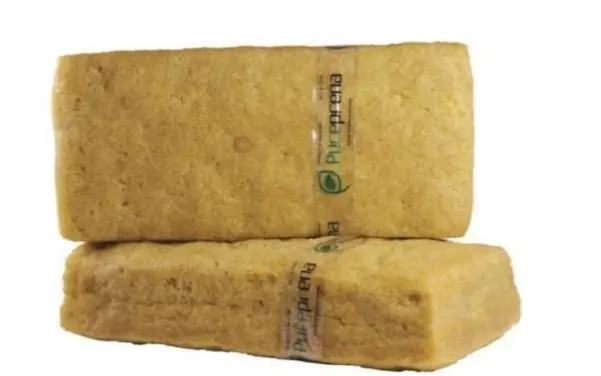
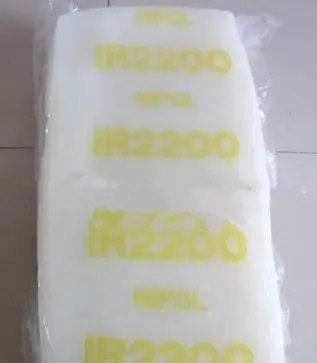
The yellowish colour represent the starting raw material from Natural Rubber source. This is differ from the synthetic counterparts which the rubber is white in colour. This is due to the none present of the non rubber in the material.
Synthetic e rubber bale
Bành cao su polyisopren tổng hợp
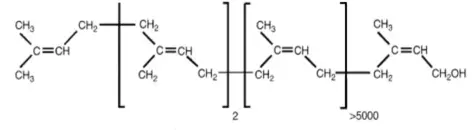
Cấu trúc hóa học của DPNR
Chemical structure of DPNR
Tiếng Việt
Cao su tự nhiên đã khử protein (DPNR) là một dạng đã tinh chế của cao su tự nhiên (NR) với hàm lượng nitơ và tro rất thấp. Nó là một loại cao su đặc biệt nhằm mục đích sử dụng trong các ứng dụng kỹ thuật đặc biệt. Nó thường được điều chế bằng cách xử lý mủ cao su NR với một proteinase (nhóm enzym thuỷ phân) để thủy phân các protein trong mủ thành các dạng dễ tan trong nước hơn, sau đó có thể bị rửa trôi trong quá trình chế biến. Việc loại bỏ hầu hết các protein và các chất chứa tro làm cho DPNR trở thành một loại cao su tinh khiết hơn nhiều.
DPNR chứa khoảng 96% hydrocacbon cao su so với khoảng 93% trong các loại Cao su Malaysia tiêu chuẩn (SMR) thương mại. Việc loại bỏ các thành phần không phải cao su (hàm lượng protein và tro) này mang lại các thuộc tính đặc biệt cho cao su, giúp tăng cường tính phù hợp của nó cho các ứng dụng sản phẩm cao su chuyên dụng. Việc này tạo ra các thuộc tính đặc biệt nhất định (cho DPNR), đặc biệt khi được kết hợp cùng với các hệ thống lưu hóa hiệu quả hòa tan.
Như vậy, DPNR có độ hút nước rất thấp so với cao su tự nhiên thông thường. Do đó, điều này làm cho nó tương đối ít nhạy cảm hơn với sự hấp thụ nước và giảm tính bất định, do đó, mang lại tính nhất quán cao hơn trong quá trình lưu hóa và mô đun lưu hóa trong điều kiện độ ẩm thay đổi.
Hơn nữa, DPNR có độ giãn nở và ứng suất thấp hơn so với cao su tự nhiên thông thường và có một số đặc tính động lực học thú vị và đặc tính dễ gia công. Tất cả các tính năng đặc biệt này tạo cho DPNR một trạng thái đặc biệt và nó được sử dụng trong các ứng dụng mà các yêu cầu đối với các thuộc tính đó rất nghiêm ngặt, ví dụ, giá đỡ chống rung, giảm xóc, giá đỡ xây dựng, giá đỡ thủy lực, …
Màu hơi vàng thể hiện nguyên liệu ban đầu từ nguồn cao su tự nhiên, khác với các loại cao su tổng hợp là cao su có màu trắng. Điều này là do không có mặt của thành phần phi cao su trong vật liệu.
Synthetic e rubber bale
Bành cao su polyisopren tổng hợp
Cấu trúc hóa học của DPNR
Chemical structure of DPNR
Notes for Section VII — PLASTICS AND ARTICLES THEREOF; RUBBER AND ARTICLES THEREOF
Notes
1. Goods put up in sets consisting of two or more separate constituents, some or all of which fall in this Section and are intended to be mixed together to obtain a product of Section VI or VII, are to be classified in the heading appropriate to that product, provided that the constituents are:
(a) having regard to the manner in which they are put up, clearly identifiable as being intended to be used together without first being repacked;
(b) presented together; and
(c) identifiable, whether by their nature or by the relative proportions in which they are present, as being complementary one to another.
2. Except for the goods of heading 39.18 or 39.19, plastics, rubber, and articles thereof, printed with motifs, characters or pictorial representations, which are not merely subsidiary to the primary use of the goods, fall in Chapter 49.
Notes for Chapter 40 — Rubber and articles thereof
Notes
1. Except where the context otherwise requires, throughout the Nomenclature the expression “rubber” means the following products, whether or not vulcanised or hard: natural rubber, balata, gutta-percha, guayule, chicle and similar natural gums, synthetic rubber, factice derived from oils, and such substances reclaimed.
2. This Chapter does not cover:
(a) Goods of Section XI (textiles and textile articles);
(b) Footwear or parts thereof of Chapter 64;
(c) Headgear or parts thereof (including bathing caps) of Chapter 65;
(d) Mechanical or electrical appliances or parts thereof of Section XVI (including electrical goods of all kinds), of hard rubber;
(e) Articles of Chapter 90, 92, 94 or 96; or
(f) Articles of Chapter 95 (other than sports gloves, mittens and mitts and articles of headings 40.11 to 40.13).
3. In headings 40.01 to 40.03 and 40.05, the expression “primary forms” applies only to the following forms:
(a) Liquids and pastes (including latex, whether or not pre-vulcanised, and other dispersions and solutions);
(b) Blocks of irregular shape, lumps, bales, powders, granules, crumbs and similar bulk forms.
4. In Note 1 to this Chapter and in heading 40.02, the expression “synthetic rubber” applies to:
(a) Unsaturated synthetic substances which can be irreversibly transformed by vulcanisation with sulphur into non-thermoplastic substances which, at a temperature between 18oC and 29oC, will not break on being extended to three times their original length and will return, after being extended to twice their original length, within a period of five minutes, to a length not greater than one and a half times their original length. For the purposes of this test, substances necessary for the cross-linking, such as vulcanising activators or accelerators, may be added; the presence of substances as provided for by Notes 5 (B)(ii) and (iii) is also permitted. However, the presence of any substances not necessary for the cross-linking, such as extenders, plasticisers and fillers, is not permitted;
(b) Thioplasts (TM); and
(c) Natural rubber modified by grafting or mixing with plastics, depolymerised natural rubber, mixtures of unsaturated synthetic substances with saturated synthetic high polymers provided that all the above-mentioned products comply with the requirements concerning vulcanisation, elongation and recovery in (a) above.
5. (A) Headings 40.01 and 40.02 do not apply to any rubber or mixture of rubbers which has been compounded, before or after coagulation, with:
(i) vulcanising agents, accelerators, retarders or activators (other than those added for the preparation of pre-vulcanised rubber latex);
(ii) pigments or other colouring matter, other than those added solely for the purpose of identification;
(iii) plasticisers or extenders (except mineral oil in the case of oil-extended rubber), fillers, reinforcing agents, organic solvents or any other substances, except those permitted under (B);
(B) The presence of the following substances in any rubber or mixture of rubbers shall not affect its classification in heading 40.01 or 40.02, as the case may be, provided that such rubber or mixture of rubbers retains its essential character as a raw material:
(i) emulsifiers or anti-tack agents;
(ii) small amounts of breakdown products of emulsifiers;
(iii) very small amounts of the following: heat-sensitive agents (generally for obtaining thermosensitive rubber latexes), cationic surface-active agents (generally for obtaining electro-positive rubber latexes), antioxidants, coagulants, crumbling agents, freeze-resisting agents, peptisers, preservatives, stabilisers, viscosity-control agents, or similar special-purpose additives.
6. For the purposes of heading 40.04, the expression “waste, parings and scrap” means rubber waste, parings and scrap from the manufacture or working of rubber and rubber goods definitely not usable as such because of cutting-up, wear or other reasons.
7. Thread wholly of vulcanised rubber, of which any cross-sectional dimension exceeds 5 mm, is to be classified as strip, rods or profile shapes, of heading 40.08.
8. Heading 40.10 includes conveyor or transmission belts or belting of textile fabric impregnated, coated, covered or laminated with rubber or made from textile yarn or cord impregnated, coated, covered or sheathed with rubber.
9. In headings 40.01, 40.02, 40.03, 40.05 and 40.08, the expressions “plates”, “sheets” and “strip” apply only to plates, sheets and strip and to blocks of regular geometric shape, uncut or simply cut to rectangular (including square) shape, whether or not having the character of articles and whether or not printed or otherwise surface-worked, but not otherwise cut to shape or further worked.
In heading 40.08 the expressions “rods” and “profile shapes” apply only to such products, whether or not cut to length or surface-worked but not otherwise worked.
Vietnam trade in subheading 4001.29
Figures cover the whole 6-digit subheading 4001.29, not code 40012994 alone — UN Comtrade only publishes to 6 digits. Latest year available for Vietnam is 2023.
Imports
- 20211.2 bn USD
- 20221.2 bn USD
- 2023591 mn USD
Top partners 2023
- Cambodia499 mn USD
- Lao People's Dem. Rep.49 mn USD
- Côte d'Ivoire29 mn USD
- Philippines8 mn USD
- Rep. of Korea2 mn USD
- Sri Lanka2 mn USD
- China1 mn USD
- Thailand548,999 USD
Exports
- 20212 mn USD
- 20221 mn USD
- 2023658,874 USD
Top partners 2023
- Egypt155,150 USD
- South Africa134,266 USD
- Rep. of Korea93,895 USD
- Malaysia69,300 USD
- Argentina61,286 USD
- India32,550 USD
- United Arab Emirates23,310 USD
- Italy21,168 USD
2025: as reported by partner countries
Vietnam has not filed 2025 yet, so this is rebuilt from what its 16 largest trading partners reported about trade with Vietnam (85% of Vietnam's trade). Not the same measure as the figures above — compare it only with the 2023 row beside it.
| Flow | 2023 | 2025 | Change |
|---|---|---|---|
| Exports | 21 mn USD | 18 mn USD | -16% |
| Imports | 12 mn USD | 4 mn USD | -69% |
- Exports 2023: partners reported 21 mn USD where Vietnam reported 658,874 USD — 31.96× on this measure.
- Imports 2023: partners reported 12 mn USD where Vietnam reported 591 mn USD — 0.02× on this measure.
The gap is not a rounding difference: goods re-exported through Hong Kong or Singapore, a different heading chosen by the importing customs, and origin-based versus destination-based attribution all pull the two measures apart. Use the year-on-year change, not the level.
Source: UN Comtrade (preview API) — reported by Vietnam. Partner totals are as reported and may differ from partner-country statistics.
Corresponding US tariff lines
Six digits are identical worldwide under the HS Convention, so 4001.29 is the same subheading in both schedules. What differs is how each country splits it: below are the 1 US line under 4001.29.
| US HTS code | Description | General duty |
|---|---|---|
| 4001.29.00.00 | Natural rubber in other forms › Other(kg) | Free |
Additional Chapter 99 duties apply to goods of Vietnam
- 9903.02.69 +20% — The duty provided in the applicable subheading + 20%
- 9903.05.84 +12.5% — The duty provided in the applicable subheading + 12.5%
These are added to the General duty above, not in place of it. Whether a given article falls inside their scope — and the exclusion lists — is set out in the U.S. notes to Chapter 99, which are prose and not machine-readable, so this site does not assign them per code. Check the official schedule before quoting a landed cost.
Already terminated: 9903.01.72 +46%
Selling to a US buyer? Screen the parties first — buyer, L/C bank and forwarder against the US restricted lists; a listed party can get the shipment held.
The General column is the rate for Vietnam: the Special column lists US preference programmes (GSP, USMCA, KORUS…) and Vietnam is in none of them. Source: USITC Harmonized Tariff Schedule of the United States — 2026 HTS Revision 18. For reference only — classification on import is decided by US Customs, and anti-dumping, countervailing and Section 232/301 measures are not covered here.
Corresponding Japanese tariff lines
4001.29 is the same subheading in both schedules (six digits are identical worldwide under the HS Convention). Vietnamese goods can enter Japan under four parallel preference routes — the columns below — and the exporter picks whichever C/O gives the better rate.
| Line | Description | MFN | VJEPA | AJCEP | CPTPP | RCEP |
|---|---|---|---|---|---|---|
| 4001.29-000 | Other(MT) | Free | Free | Free | Free | Free |
MFN is the lowest of the schedule's General/Temporary/WTO columns (hover to see all three). The preference columns require the matching certificate of origin; an em dash means that agreement gives no preference for the line. Source: Japan's Tariff Schedule, Japan Customs (as of August 8, 2026). For reference only — classification on import is decided by Japan Customs.
Codes at the same level under “Other, in primary forms:”
Check neighbouring codes to make sure the classification fits best.
Data updated: 11/08/2026 · Found wrong or missing data? Report a data error