Other › Obtained by a combination of mechanical and chemical processes
4706.93.10 — Abaca pulp
Bột giấy abaca (SEN)
Unit: kg (kg)
Hồ sơ mã HS — hscodevn.com/hs/47069310 · in ngày 15/9/2026 · chỉ mang tính tham khảo, đối chiếu văn bản pháp lý hiện hành
HS code 47069310 covers abaca pulp under heading 4706 (pulps of fibres derived from recovered (waste and scrap) paper or paperboard or of other fibrous cellulosic material), Chapter 47. The MFN import duty is 0%; the lowest FTA rate is 0% under ASEAN - China (ACFTA) (C/O form E required). VAT: 8/10%. Unit of quantity: kg.
MFN import duty
0%
Lowest FTA
0%
ASEAN - China (ACFTA)
VAT
8/10%
8% under the current reduction · 10% standard
Excise / Env. tax
—
Not subject
Import duty comparison across FTA schedules
Full table with legal documents & effective dates
| Tax / Schedule | Rate | Document | Effective |
|---|---|---|---|
| Preferential import duty (MFN) | 0% | 26/2023/NĐ-CP | 15/07/2023 |
| Ordinary import duty | 5% | 15/2023/QĐ-TTg | 15/07/2023 |
| ASEAN (ATIGA)(2026) | 0% | 126/2022/NĐ-CP | 30/12/2022 |
| ASEAN - China (ACFTA) | 0% | 118/2022/NĐ-CP | 30/12/2022 |
| ASEAN - Japan (AJCEP)(01/04/2026 - 31/3/2027) | 0% | 120/2022/NĐ-CP | 30/12/2022 |
| Vietnam - Japan (VJEPA)(1/4/2026 - 31/3/2027) | 0% | 124/2022/NĐ-CP | 30/12/2022 |
| ASEAN - Korea (AKFTA) | 0% | 119/2022/NĐ-CP | 30/12/2022 |
| ASEAN - Australia/New Zealand (AANZFTA) | 0% | 121/2022/NĐ-CP | 30/12/2022 |
| ASEAN - India (AIFTA)(01/01/2026 - 31/12/2026) | 0% | 122/2022/NĐ-CP | 30/12/2022 |
| Vietnam - Korea (VKFTA)(2026) | 0% | 125/2022/NĐ-CP | 30/12/2022 |
| Vietnam - Chile (VCFTA)(2026) | 0% | 112/2022/NĐ-CP | 30/12/2022 |
| Vietnam - Eurasian Economic Union (VN-EAEU)(2026) | 0% | 113/2022/NĐ-CP | 30/12/2022 |
| CPTPP Agreement(2026) | 0% | 115/2022/NĐ-CP | 30/12/2022 |
| ASEAN - Hong Kong (AHKFTA)(2026) | 0% | 123/2022/NĐ-CP | 30/12/2022 |
| Vietnam - EU (EVFTA)(2026) | 0% | 116/2022/NĐ-CP | 30/12/2022 |
| Vietnam - UK (UKVFTA)(2026) | 0% | 117/2022/NĐ-CP | 30/12/2022 |
| Vietnam - Laos | 0% | 206/2025/NĐ-CP | 15/07/2025 |
| Vietnam - Israel (VIFTA)(2026) | 0% | 131/2024/NĐ-CP | 15/10/2024 |
| RCEP - Group A (ASEAN)(2026) | 0% | 129/2022/NĐ-CP | 30/12/2022 |
| RCEP - Group B (China)(2026) | 0% | 129/2022/NĐ-CP | 30/12/2022 |
| RCEP - Group C (Korea)(2026) | 0% | 129/2022/NĐ-CP | 30/12/2022 |
| RCEP - Group D (Japan)(2026) | 0% | 129/2022/NĐ-CP | 30/12/2022 |
| RCEP - Group E (Australia)(2026) | 0% | 129/2022/NĐ-CP | 30/12/2022 |
| RCEP - Group F (New Zealand)(2026) | 0% | 129/2022/NĐ-CP | 30/12/2022 |
FTA schedules are cut annually: the rate shown applies to the period in brackets, per the decree's appendix.
VAT · Excise tax · Environmental protection tax
| Tax / Schedule | Rate | Document | Effective |
|---|---|---|---|
| Value added tax (VAT) | 8/10% | 181/2025/NĐ-CP | 01/07/2025 |
Rules of origin by FTA
To claim an FTA rate the goods must meet the origin criterion below AND carry a valid C/O — the right HS code alone is not enough. Step-by-step self-check →
- - Obtained by a combination of mechanical and chemical processes:
RVC(40) or CTH
RVC(40) hoặc CTH
CTHRVC40
Source: Circular No. 44/2025/TT-BCT · annex uses HS 2022 while this site uses AHTN 2022 — check headings that changed between versions
Pulps of fibres derived from recovered (waste and scrap) paper or paperboard or of other fibrous cellulosic material
CTH
CTH
CTH
Source: Circular No. 03/2019/TT-BCT · annex uses HS 2012 while this site uses AHTN 2022 — check headings that changed between versions
Pulp of wood or of other fibrous cellulosic material; recovered (waste and scrap) paper or paperboard
Manufacture using materials of any heading, except that of the product; or the value of the materials used does not exceed 70% of the ex-works price of the product.
Sử dụng nguyên liệu từ bất kỳ Nhóm nào để sản xuất, ngoại trừ Nhóm của sản phẩm; hoặc Trị giá nguyên liệu được sử dụng không vượt quá 70% giá xuất xưởng của sản phẩm.
Source: Circular No. 14/2026/TT-BCT
Pulps of fibres derived from recovered (waste and scrap) paper or paperboard or of other fibrous cellulosic material
CTH or RVC40
CTH hoặc RVC40
CTHRVC40
Source: Circular No. 32/2022/TT-BCT · annex uses HS 2022 while this site uses AHTN 2022 — check headings that changed between versions
Pulp of wood or of other fibrous cellulosic material; recovered (waste and scrap) paper or paperboard
Manufacture from materials of any heading, except that of the product; or the value of the materials does not exceed 70% of the ex-works price of the product.
Sản xuất từ nguyên liệu thuộc bất kỳ Nhóm nào, ngoại trừ Nhóm của sản phẩm; hoặc trị giá nguyên liệu không vượt quá 70% giá xuất xưởng của sản phẩm.
Source: Circular No. 02/2021/TT-BCT
Pulp of wood or of other fibrous cellulosic material; recovered (waste and scrap) paper or paperboard
CTH
CTH
CTH
or
50%
50%
Source: Circular No. 11/2024/TT-BCT
- - Obtained by a combination of mechanical and chemical processes:
CTH or RVC(40)
CTH hoặc RVC(40)
CTHRVC40
Source: Circular No. 09/2022/TT-BCT · annex uses HS 2017 while this site uses AHTN 2022 — check headings that changed between versions
- - Obtained by a combination of mechanical and chemical processes:
CTH
CTH
CTH
Source: Circular No. 01/2024/TT-BCT · annex uses HS 2022 while this site uses AHTN 2022 — check headings that changed between versions
Pulp of wood or of other fibrous cellulosic material; recovered (waste and scrap) paper or paperboard
CTH
CTH
CTH
or
QVC 35%
QVC 35%
QVC35
Source: Circular No. 24/2026/TT-BCT · annex uses HS 2022 while this site uses AHTN 2022 — check headings that changed between versions
Agreements with no rule specific to this code
This code carries a preferential rate under the agreements below but has no line of its own in the product-specific rules annex. The goods must still meet an origin requirement.
The agreement sets a general rule for codes outside the annex:
1. The goods referred to in Clause 3, Article 5 of this Circular, other than the goods provided in Clause 2 of this Article, are considered originating if:
a) The goods have a regional value content (RVC) of not less than 40% of the FOB value calculated in accordance with Article 8 of this Circular and the last production process is carried out in a Member State; or
b) Goods of Chapters 25, 26, 28, 29, 31 and 39; Chapters 42 to 49; Chapters 57 to 59; Chapters 61, 62 and 64; Chapters 66 to 71; Chapters 73 to 83; Chapters 86 and 88; and Chapters 91 to 97 of the Harmonized Commodity Description and Coding System using non-originating materials undergo a change in tariff classification at the 4-digit level (CTH), except for headings 29.01, 29.02, 31.05, 39.01, 39.02, 39.03, 39.07 and 39.08, to which the RVC 40% origin criterion applies.
CTHRVC40
Source: Circular No. 12/2019/TT-BCT · Article 7(1)
The agreement sets a general rule for codes outside the annex:
1. The goods referred to in Clause 3, Article 5 of this Circular, other than the goods provided in Clause 2 of this Article, are considered originating if they have an RVC of not less than 40% calculated in accordance with Article 8 of this Circular.
Source: Circular No. 21/2019/TT-BCT · Article 7(1)
The agreement sets a general rule for codes outside the annex:
1. Products referred to in Clause 2, Article 2 are considered originating if:
a) The AIFTA content is not less than thirty-five per cent (35%) of the FOB value; and
b) The non-originating materials used in the production of that product have undergone a change in tariff classification at the six (6)-digit level (CTSH) of the Harmonized System.
provided that the last production process is carried out in the territory of the exporting Member State.
CTSH
Source: Circular No. 15/2010/TT-BCT · Article 4(1) of Appendix 1
The agreement sets a general rule for codes outside the annex:
1. For the purposes of paragraph 2 of Article 5 of this Circular, goods shall be considered as originating in a Member State in one of the following cases:
a) The Regional Value Content (RVC) is not less than 40%, calculated according to the formula provided for in Article 8 of this Circular, and the final process of production is performed in that Member State.
b) All non-originating materials used in the production of the goods have undergone a change in tariff classification (CTC) at the four (04)-digit level (change of Heading) of the Harmonized Commodity Description and Coding System in that Member State.
The exporter of each Member State may choose to apply the origin criterion provided for in point a or point b of paragraph 1 of this Article to determine the origin of goods.
CTC
Source: Circular No. 37/2022/TT-BCT · Article 7(1)
The agreement sets a general rule for codes outside the annex:
1. For the purposes of point b clause 1 Article 5 of this Circular, goods not covered by Article 8 of this Circular shall be considered as originating if they have a regional value content (hereinafter referred to as RVC) of at least 40% of the FOB value, or if they have undergone a change in tariff classification at the 4-digit level (hereinafter referred to as CTH) of the Harmonized System.
CTH
Source: Circular No. 49/2025/TT-BCT · Article 7(1)
The agreement sets a general rule for codes outside the annex:
1. General origin criteria:
a) Goods referred to in Clause 2, Article 2 of this Appendix are considered originating in the Member State where the production or processing of those goods took place if:
- The goods have a regional value content (hereinafter referred to as the “ASEAN Value Content” or the “Regional Value Content (RVC)”) of not less than 40% (forty per cent), calculated in accordance with the formula provided in Article 5 of this Appendix; or
- All non-originating materials used in the production of those goods have undergone a change in tariff classification (hereinafter referred to as “CTC”) at the 4 (four)-digit level (that is, a change of heading) of the Harmonized System.
b) Each Member State shall allow the exporter of the goods to decide whether to use the criterion of “RVC of not less than 40% (forty per cent)” or that of “a change in tariff classification at the 4 (four)-digit level” referred to at Point a, Clause 1 in determining the origin of the goods.
CTC
Source: Circular No. 22/2016/TT-BCT · Article 4(1) of Appendix I
The agreement sets a general rule for codes outside the annex:
1. For the purposes of Clause 2, Article 2, goods are considered originating in the Member State where the production or processing took place if:
a) The goods have a regional value content (RVC) of not less than forty per cent (40%), calculated in accordance with Article 5; or
b) All the non-originating materials used in the production of those goods undergo a change in tariff classification (hereinafter referred to as “CTC”) at the four (4)-digit level (that is, a change of heading) of the Harmonized System.
2. Each Member State shall allow the exporter to use either of the criteria provided at Point a, Clause 1 or Point b, Clause 1 of this Article to determine the origin of the goods.
CTC
Source: Circular No. 31/2013/TT-BCT · Article 4(1)
The agreement sets a general rule for codes outside the annex:
1. For the purposes of Clause 2, Article 2, goods are considered originating in a Member State if:
a) The goods have a local value content (hereinafter referred to as “LVC”), calculated in accordance with the formula provided in Article 5, of not less than forty (40) per cent, and the last production process for those goods is carried out in that Member State; or
b) All non-originating materials used in the production of the goods in that Member State have undergone a change in tariff classification (hereinafter referred to as CTC) at the 4-digit level (change of heading) under the Harmonized System.
CTCLVC
Source: Circular No. 10/2009/TT-BCT · Article 4(1) of Appendix 1
The agreement sets a general rule for codes outside the annex:
1. General origin criterion
a) Goods specified in Clause 2 of Article 2 shall be considered as originating in the Member State where the working or processing of those goods has taken place if:
- The goods have a regional value content (hereinafter referred to as the “Viet Nam - Laos value content” or the “regional value content (LVC)”) of not less than forty percent (40%), calculated in accordance with the formula provided in Article 5; or
- All non-originating materials used in the production of those goods have undergone a change in tariff classification (hereinafter referred to as “CTC”) at the four (4)-digit level (meaning a change of heading) of the Harmonized System.
b) Each Member State shall allow the exporter of the goods to decide to use either of the two criteria “LVC of not less than forty percent (40%)” or “change in tariff classification at the four (04)-digit level” referred to at point a of Clause 1 in order to determine the origin of the goods.
CTCLVC
Source: Circular No. 04/2010/TT-BCT · Article 4(1) of Appendix 1
Criteria are translated for reference; the Vietnamese wording quoted underneath is the binding text.
Supplementary Explanatory Notes (SEN, ASEAN 2022)
Product description4706.93.10ABACA PULP
BỘT GIẤY ABACA
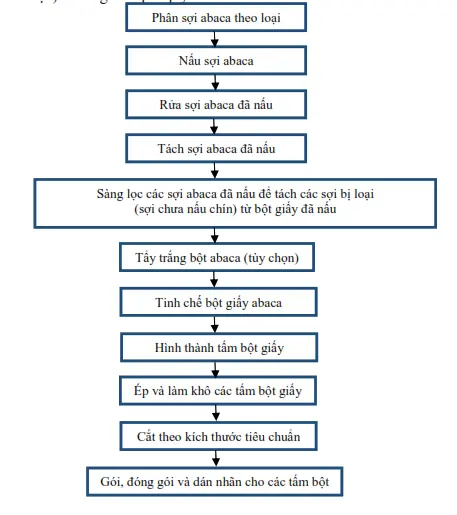
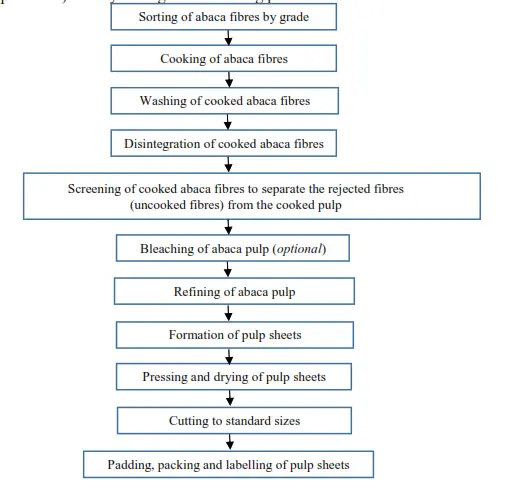
Abaca (musa textilis) fibres processed into abaca pulp through chemi- mechanical pulping process (i.e., combination of mechanical and chemical processes) usually undergo the following procedure:
Abaca pulp is generally prepared in standard size sheets and shipped in bales. It is rehydrated and used in making specialty papers (e.g., tea and coffee bags, sausage casing paper, currency notes, cigarette filter papers, medical/food preparation/disposal papers, high-quality writing paper, vacuum bags and more, where the principally desired characteristics are good strength and porosity, and in general, substantial wet strength.
A scanning electron micrograph of a web of alpha-cellulose abaca fibres shows the relative smooth, straight nature of fibres. The pulp cellulose fibre has a mean length of 4 mm to 6 mm; and mean diameter of 17 to 21 microns. It has a narrow-pointed end. By comparison, typical wood pulp has a fibre length of from 2 mm to 3mm and a diameter of about 40 microns. The high ratio of fibre length and fibre width partially explains the remarkable properties of abaca pulp.
Tiếng Việt
Sợi abaca (musa textilis) được chế biến thành bột giấy abaca thông qua quá trình làm bột giấy hóa cơ (tức là, kết hợp quá trình sản xuất cơ học và hóa học) thường trải qua quy trình sau:
Bột giấy Abaca thường được chế biến ở dạng tấm có kích thước tiêu chuẩn và được vận chuyển theo từng kiện. Chúng được thêm nước và được sử dụng trong việc sản xuất các loại giấy đặc biệt (ví dụ, túi trà và cà phê, giấy bọc xúc xích, tiền giấy, giấy lọc thuốc lá, giấy chuẩn bị/tiêu hủy y tế / thực phẩm, giấy viết chất lượng cao, túi hút chân không, chủ yếu đặc điểm là độ bền và độ xốp tốt, thường độ bền ướt đáng kể.
Ảnh hiển vi điện tử của mạng xơ sợi abaca alpha-xenlulo cho thấy bản chất tương đối mịn, thẳng của sợi. Sợi xenlulo trong bột giấy abaca có chiều dài từ 4 mm đến 6 mm; và đường kính từ 17 đến 21 micron. Chúng có một đầu nhọn hẹp. Để so sánh, bột giấy tiêu chuẩn có chiều dài sợi từ 2 mm đến 3 mm và đường kính khoảng 40 micron. Tỷ lệ chiều dài so với chiều rộng sợi ở mức cao thể hiện một phần các đặc tính đáng chú ý của bột giấy abaca.
Notes for Chapter 47 — Pulp of wood or of other fibrous cellulosic material; recovered (waste and scrap) paper or paperboard
1. For the purposes of heading 47.02, the expression "chemical wood pulp, dissolving grades" means chemical wood pulp having by weight an insoluble fraction of 92% or more for soda or sulphate wood pulp or of 88% or more for sulphite wood pulp after one hour in a caustic soda solution containing 18% sodium hydroxide (NaOH) at 20oC, and for sulphite wood pulp an ash content that does not exceed 0.15% by weight.
Vietnam trade in subheading 4706.93
Figures cover the whole 6-digit subheading 4706.93, not code 47069310 alone — UN Comtrade only publishes to 6 digits. Latest year available for Vietnam is 2023.
Imports
- 20212 mn USD
- 20221 mn USD
- 20231 mn USD
Top partners 2023
- Rep. of Korea441,147 USD
- China189,375 USD
- Japan98,290 USD
- Canada94,419 USD
- Philippines91,932 USD
- Thailand87,090 USD
- Russian Federation50,919 USD
- Norway25,832 USD
2025: as reported by partner countries
Vietnam has not filed 2025 yet, so this is rebuilt from what its 16 largest trading partners reported about trade with Vietnam (85% of Vietnam's trade). Not the same measure as the figures above — compare it only with the 2023 row beside it.
| Flow | 2023 | 2025 | Change |
|---|---|---|---|
| Imports | 168,507 USD | 213,365 USD | +27% |
- Imports 2023: partners reported 168,507 USD where Vietnam reported 1 mn USD — 0.15× on this measure.
The gap is not a rounding difference: goods re-exported through Hong Kong or Singapore, a different heading chosen by the importing customs, and origin-based versus destination-based attribution all pull the two measures apart. Use the year-on-year change, not the level.
Source: UN Comtrade (preview API) — reported by Vietnam. Partner totals are as reported and may differ from partner-country statistics.
Corresponding US tariff lines
Six digits are identical worldwide under the HS Convention, so 4706.93 is the same subheading in both schedules. What differs is how each country splits it: below are the 1 US line under 4706.93.
| US HTS code | Description | General duty |
|---|---|---|
| 4706.93.01.00 | Other › Obtained by a combination of mechanical and chemical processes(t adw) | Free |
Additional Chapter 99 duties apply to goods of Vietnam
- 9903.02.69 +20% — The duty provided in the applicable subheading + 20%
- 9903.05.84 +12.5% — The duty provided in the applicable subheading + 12.5%
These are added to the General duty above, not in place of it. Whether a given article falls inside their scope — and the exclusion lists — is set out in the U.S. notes to Chapter 99, which are prose and not machine-readable, so this site does not assign them per code. Check the official schedule before quoting a landed cost.
Already terminated: 9903.01.72 +46%
Selling to a US buyer? Screen the parties first — buyer, L/C bank and forwarder against the US restricted lists; a listed party can get the shipment held.
The General column is the rate for Vietnam: the Special column lists US preference programmes (GSP, USMCA, KORUS…) and Vietnam is in none of them. Source: USITC Harmonized Tariff Schedule of the United States — 2026 HTS Revision 18. For reference only — classification on import is decided by US Customs, and anti-dumping, countervailing and Section 232/301 measures are not covered here.
Corresponding Japanese tariff lines
4706.93 is the same subheading in both schedules (six digits are identical worldwide under the HS Convention). Vietnamese goods can enter Japan under four parallel preference routes — the columns below — and the exporter picks whichever C/O gives the better rate.
| Line | Description | MFN | VJEPA | AJCEP | CPTPP | RCEP |
|---|---|---|---|---|---|---|
| 4706.93-000 | Obtained by a combination of mechanical and chemical processes(MT) | Free | Free | Free | Free | Free |
MFN is the lowest of the schedule's General/Temporary/WTO columns (hover to see all three). The preference columns require the matching certificate of origin; an em dash means that agreement gives no preference for the line. Source: Japan's Tariff Schedule, Japan Customs (as of August 8, 2026). For reference only — classification on import is decided by Japan Customs.
Codes at the same level under 470693
Check neighbouring codes to make sure the classification fits best.
Data updated: 11/08/2026 · Found wrong or missing data? Report a data error