Other articles of copper › Other
7419.80.60 — Articles specially designed for use during religious rites
Các vật dụng được thiết kế riêng sử dụng trong nghi lễ tôn giáo (SEN)
Unit: kg/unit (kg/chiếc)
Hồ sơ mã HS — hscodevn.com/hs/74198060 · in ngày 15/9/2026 · chỉ mang tính tham khảo, đối chiếu văn bản pháp lý hiện hành
HS code 74198060 covers articles specially designed for use during religious rites under heading 7419 (other articles of copper), Chapter 74. The MFN import duty is 5%; the lowest FTA rate is 0% under ASEAN - China (ACFTA) (C/O form E required). VAT: 10/8%. Unit of quantity: kg/unit.
MFN import duty
5%
Lowest FTA
0%
ASEAN - China (ACFTA)
VAT
10/8%
8% under the current reduction · 10% standard
Excise / Env. tax
—
Not subject
Distinguish from heading:5809Woven fabrics of metal thread…8311Wire, rods, tubes, plates…7117Imitation jewellery7325Other cast articles of iron or…9114Other clock or watch parts9604Hand sieves and hand riddles
Import duty comparison across FTA schedules
Full table with legal documents & effective dates
| Tax / Schedule | Rate | Document | Effective |
|---|---|---|---|
| Preferential import duty (MFN) | 5% | 26/2023/NĐ-CP | 15/07/2023 |
| Ordinary import duty | 7.5% | 15/2023/QĐ-TTg | 15/07/2023 |
| ASEAN (ATIGA)(2026) | 0% | 126/2022/NĐ-CP | 30/12/2022 |
| ASEAN - China (ACFTA) | 0% | 118/2022/NĐ-CP | 30/12/2022 |
| ASEAN - Japan (AJCEP)(01/04/2026 - 31/3/2027) | 0% | 120/2022/NĐ-CP | 30/12/2022 |
| Vietnam - Japan (VJEPA)(1/4/2026 - 31/3/2027) | 0% | 124/2022/NĐ-CP | 30/12/2022 |
| ASEAN - Korea (AKFTA) | 0% | 119/2022/NĐ-CP | 30/12/2022 |
| ASEAN - Australia/New Zealand (AANZFTA) | 0% | 121/2022/NĐ-CP | 30/12/2022 |
| ASEAN - India (AIFTA)(01/01/2026 - 31/12/2026) | 0% | 122/2022/NĐ-CP | 30/12/2022 |
| Vietnam - Korea (VKFTA)(2026) | 0% | 125/2022/NĐ-CP | 30/12/2022 |
| Vietnam - Chile (VCFTA)(2026) | 0% | 112/2022/NĐ-CP | 30/12/2022 |
| Vietnam - Eurasian Economic Union (VN-EAEU)(2026) | 0% | 113/2022/NĐ-CP | 30/12/2022 |
| CPTPP Agreement(2026) | 0% | 115/2022/NĐ-CP | 30/12/2022 |
| ASEAN - Hong Kong (AHKFTA)(2026) | 0% | 123/2022/NĐ-CP | 30/12/2022 |
| Vietnam - EU (EVFTA)(2026) | 0% | 116/2022/NĐ-CP | 30/12/2022 |
| Vietnam - UK (UKVFTA)(2026) | 0% | 117/2022/NĐ-CP | 30/12/2022 |
| Vietnam - Laos | 0% | 206/2025/NĐ-CP | 15/07/2025 |
| Vietnam - Israel (VIFTA)(2026) | 3,5% | 131/2024/NĐ-CP | 15/10/2024 |
| RCEP - Group A (ASEAN)(2026) | 0% | 129/2022/NĐ-CP | 30/12/2022 |
| RCEP - Group B (China)(2026) | 0% | 129/2022/NĐ-CP | 30/12/2022 |
| RCEP - Group C (Korea)(2026) | 0% | 129/2022/NĐ-CP | 30/12/2022 |
| RCEP - Group D (Japan)(2026) | 0% | 129/2022/NĐ-CP | 30/12/2022 |
| RCEP - Group E (Australia)(2026) | 0% | 129/2022/NĐ-CP | 30/12/2022 |
| RCEP - Group F (New Zealand)(2026) | 0% | 129/2022/NĐ-CP | 30/12/2022 |
FTA schedules are cut annually: the rate shown applies to the period in brackets, per the decree's appendix.
FTA duty phase-down
Upcoming reductions for this code — the new rate takes effect on this site automatically on the effective date.
- Vietnam - Israel (VIFTA)3,5% (2026)3%from 01/01/2027…continues per the schedule — see the decree annex
- Vietnam - UAE (CEPA)4,4%3,8%from 01/01/2027…continues per the schedule — see the decree annex
Only the steps present in the data (each schedule's next period) are shown. A schedule not reaching 0% here does not mean it stops — the full schedule is in the decree annex.
VAT · Excise tax · Environmental protection tax
| Tax / Schedule | Rate | Document | Effective |
|---|---|---|---|
| Value added tax (VAT) | 10/8% | 174/2025/NĐ-CP - PL1 | 30/06/20025 |
VAT reduction: Not eligible for the VAT reduction under 174/2025/NĐ-CP - PL1: Copper > Semi-finished products of lead, zinc, tin or their alloys. (Reference: 2-digit HS code)
Export duty
| Tax / Schedule | Rate | Document | Effective |
|---|---|---|---|
| Export duty | 0% | 26/2023/NĐ-CP | 31/05/2023 |
Rules of origin by FTA
To claim an FTA rate the goods must meet the origin criterion below AND carry a valid C/O — the right HS code alone is not enough. Step-by-step self-check →
- Other:
RVC(40) or CTH
RVC(40) hoặc CTH
CTHRVC40
Source: Circular No. 44/2025/TT-BCT · annex uses HS 2022 while this site uses AHTN 2022 — check headings that changed between versions
- Other:
CTH; hoặc RVC không thấp hơn: a) 40% theo công thức tính trực tiếp; hoặc b) 50% theo công thức tính gián tiếp; hoặc c) 60% theo công thức tính giá trị tập trung đối với nguyên liệu không có xuất xứ thuộc nhóm 74.19.
CTH
Source: Circular No. 03/2019/TT-BCT · annex uses HS 2012 while this site uses AHTN 2022 — check headings that changed between versions
Copper and articles thereof; except:
Manufacture using materials of any heading, except that of the product.
Sử dụng nguyên liệu từ bất kỳ Nhóm nào để sản xuất, ngoại trừ Nhóm của sản phẩm.
Source: Circular No. 14/2026/TT-BCT
Other articles of copper
CTH or RVC40
CTH hoặc RVC40
CTHRVC40
Source: Circular No. 32/2022/TT-BCT · annex uses HS 2022 while this site uses AHTN 2022 — check headings that changed between versions
Copper and articles thereof; except:
Manufacture from materials of any heading, except that of the product.
Sản xuất từ nguyên liệu thuộc bất kỳ Nhóm nào, ngoại trừ Nhóm của sản phẩm.
Source: Circular No. 02/2021/TT-BCT
- Other:
CTH or VAC 50%
CTH hoặc VAC 50%
CTH
Source: Circular No. 01/2024/TT-BCT · annex uses HS 2022 while this site uses AHTN 2022 — check headings that changed between versions
Copper and articles thereof
CTH
CTH
CTH
or
QVC 35%
QVC 35%
QVC35
Source: Circular No. 24/2026/TT-BCT · annex uses HS 2022 while this site uses AHTN 2022 — check headings that changed between versions
Agreements with no rule specific to this code
This code carries a preferential rate under the agreements below but has no line of its own in the product-specific rules annex. The goods must still meet an origin requirement.
The agreement sets a general rule for codes outside the annex:
1. The goods referred to in Clause 3, Article 5 of this Circular, other than the goods provided in Clause 2 of this Article, are considered originating if:
a) The goods have a regional value content (RVC) of not less than 40% of the FOB value calculated in accordance with Article 8 of this Circular and the last production process is carried out in a Member State; or
b) Goods of Chapters 25, 26, 28, 29, 31 and 39; Chapters 42 to 49; Chapters 57 to 59; Chapters 61, 62 and 64; Chapters 66 to 71; Chapters 73 to 83; Chapters 86 and 88; and Chapters 91 to 97 of the Harmonized Commodity Description and Coding System using non-originating materials undergo a change in tariff classification at the 4-digit level (CTH), except for headings 29.01, 29.02, 31.05, 39.01, 39.02, 39.03, 39.07 and 39.08, to which the RVC 40% origin criterion applies.
CTHRVC40
Source: Circular No. 12/2019/TT-BCT · Article 7(1)
The agreement sets a general rule for codes outside the annex:
1. The goods referred to in Clause 3, Article 5 of this Circular, other than the goods provided in Clause 2 of this Article, are considered originating if they have an RVC of not less than 40% calculated in accordance with Article 8 of this Circular.
Source: Circular No. 21/2019/TT-BCT · Article 7(1)
The agreement sets a general rule for codes outside the annex:
1. Products referred to in Clause 2, Article 2 are considered originating if:
a) The AIFTA content is not less than thirty-five per cent (35%) of the FOB value; and
b) The non-originating materials used in the production of that product have undergone a change in tariff classification at the six (6)-digit level (CTSH) of the Harmonized System.
provided that the last production process is carried out in the territory of the exporting Member State.
CTSH
Source: Circular No. 15/2010/TT-BCT · Article 4(1) of Appendix 1
The agreement sets a general rule for codes outside the annex:
1. For the purposes of paragraph 2 of Article 5 of this Circular, goods shall be considered as originating in a Member State in one of the following cases:
a) The Regional Value Content (RVC) is not less than 40%, calculated according to the formula provided for in Article 8 of this Circular, and the final process of production is performed in that Member State.
b) All non-originating materials used in the production of the goods have undergone a change in tariff classification (CTC) at the four (04)-digit level (change of Heading) of the Harmonized Commodity Description and Coding System in that Member State.
The exporter of each Member State may choose to apply the origin criterion provided for in point a or point b of paragraph 1 of this Article to determine the origin of goods.
CTC
Source: Circular No. 37/2022/TT-BCT · Article 7(1)
The agreement sets a general rule for codes outside the annex:
1. For the purposes of point b clause 1 Article 5 of this Circular, goods not covered by Article 8 of this Circular shall be considered as originating if they have a regional value content (hereinafter referred to as RVC) of at least 40% of the FOB value, or if they have undergone a change in tariff classification at the 4-digit level (hereinafter referred to as CTH) of the Harmonized System.
CTH
Source: Circular No. 49/2025/TT-BCT · Article 7(1)
The agreement sets a general rule for codes outside the annex:
1. General origin criteria:
a) Goods referred to in Clause 2, Article 2 of this Appendix are considered originating in the Member State where the production or processing of those goods took place if:
- The goods have a regional value content (hereinafter referred to as the “ASEAN Value Content” or the “Regional Value Content (RVC)”) of not less than 40% (forty per cent), calculated in accordance with the formula provided in Article 5 of this Appendix; or
- All non-originating materials used in the production of those goods have undergone a change in tariff classification (hereinafter referred to as “CTC”) at the 4 (four)-digit level (that is, a change of heading) of the Harmonized System.
b) Each Member State shall allow the exporter of the goods to decide whether to use the criterion of “RVC of not less than 40% (forty per cent)” or that of “a change in tariff classification at the 4 (four)-digit level” referred to at Point a, Clause 1 in determining the origin of the goods.
CTC
Source: Circular No. 22/2016/TT-BCT · Article 4(1) of Appendix I
The agreement sets a general rule for codes outside the annex:
1. For the purposes of Clause 2, Article 2, goods are considered originating in a Member State if:
a) The goods have a local value content (hereinafter referred to as “LVC”), calculated in accordance with the formula provided in Article 5, of not less than forty (40) per cent, and the last production process for those goods is carried out in that Member State; or
b) All non-originating materials used in the production of the goods in that Member State have undergone a change in tariff classification (hereinafter referred to as CTC) at the 4-digit level (change of heading) under the Harmonized System.
CTCLVC
Source: Circular No. 10/2009/TT-BCT · Article 4(1) of Appendix 1
The agreement sets NO general rule. Apart from wholly obtained goods and goods produced entirely from originating materials, the only route is to meet the annex — and no annex line matches this code, so check the circular itself:
1. For the purposes of Point b, Clause 1, Article 2 of this Appendix, goods that are not wholly obtained are considered originating if they satisfy the Product Specific Rules provided in Appendix II.
Source: Circular No. 40/2015/TT-BCT · Article 4(1) of Appendix I
The agreement sets a general rule for codes outside the annex:
1. General origin criterion
a) Goods specified in Clause 2 of Article 2 shall be considered as originating in the Member State where the working or processing of those goods has taken place if:
- The goods have a regional value content (hereinafter referred to as the “Viet Nam - Laos value content” or the “regional value content (LVC)”) of not less than forty percent (40%), calculated in accordance with the formula provided in Article 5; or
- All non-originating materials used in the production of those goods have undergone a change in tariff classification (hereinafter referred to as “CTC”) at the four (4)-digit level (meaning a change of heading) of the Harmonized System.
b) Each Member State shall allow the exporter of the goods to decide to use either of the two criteria “LVC of not less than forty percent (40%)” or “change in tariff classification at the four (04)-digit level” referred to at point a of Clause 1 in order to determine the origin of the goods.
CTCLVC
Source: Circular No. 04/2010/TT-BCT · Article 4(1) of Appendix 1
Criteria are translated for reference; the Vietnamese wording quoted underneath is the binding text.
Commodity policy for this HS code
Unofficial English rendering of the Vietnamese source; the document numbers link to the full text.
Managing authority: Ministry of Industry and Trade
- List of goods bought, sold, and exchanged through auxiliary border gates and border openings by traders (42/2019/TT-BCT, 33/2025/TT-BCT)Listed· Ministry of Industry and Trade
Related documents (full text)
Supplementary Explanatory Notes (SEN, ASEAN 2022)
Product description7419.80.60ARTICLES SPECIALLY DESIGNED FOR USE DURING RELIGIOUS RITES
CÁC VẬT DỤNG ĐƯỢC THIẾT KẾ RIÊNG SỬ DỤNG TRONG NGHI LỄ TÔN GIÁO
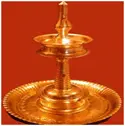
Articles made of copper that are used during religious rituals (e.g., Buddhist, Hindu or Christian), having a special design and shape, such as cups, bowls or statuettes representing human or non-human creatures. To be classified under this subheading the goods must be identifiable as being used during religious rites.
Tiếng Việt
Vật dụng làm bằng đồng được sử dụng trong các nghi lễ tôn giáo (ví dụ, đạo Phật, đạo Hindu hoặc Thiên Chúa Giáo), có hình dáng và thiết kế đặc biệt như cốc, bát hoặc tượng hình người hoặc các sinh vật khác. Để được xếp vào phân nhóm này, hàng hoá đó phải được nhận biết là chúng được sử dụng trong các nghi lễ tôn giáo.
Notes for Section XV — BASE METALS AND ARTICLES OF BASE METAL
Notes
1. This Section does not cover:
(a) Prepared paints, inks or other products with a basis of metallic flakes or powder (headings 32.07 to 32.10, 32.12, 32.13 or 32.15);
(b) Ferro-cerium or other pyrophoric alloys (heading 36.06);
(c) Headgear or parts thereof of heading 65.06 or 65.07;
(d) Umbrella frames or other articles of heading 66.03;
(e) Goods of Chapter 71 (for example, precious metal alloys, base metal clad with precious metal, imitation jewellery);
(f) Articles of Section XVI (machinery, mechanical appliances and electrical goods);
(g) Assembled railway or tramway track (heading 86.08) or other articles of Section XVII (vehicles, ships and boats, aircraft);
(h) Instruments or apparatus of Section XVIII, including clock or watch springs;
(ij) Lead shot prepared for ammunition (heading 93.06) or other articles of Section XIX (arms and ammunition);
(k) Articles of Chapter 94 (for example, furniture, mattress supports, luminaires and lighting fittings, illuminated signs, prefabricated buildings);
(l) Articles of Chapter 95 (for example, toys, games, sports requisites);
(m) Hand sieves, buttons, pens, pencil-holders, pen nibs, monopods, bipods, tripods and similar articles or other articles of Chapter 96 (miscellaneous manufactured articles); or
(n) Articles of Chapter 97 (for example, works of art).
2. Throughout the Nomenclature, the expression “parts of general use” means:
(a) Articles of heading 73.07, 73.12, 73.15, 73.17 or 73.18 and similar articles of other base metal, other than articles specially designed for use exclusively in implants in medical, surgical, dental or veterinary sciences (heading 90.21);
(b) Springs and leaves for springs, of base metal, other than clock or watch springs (heading 91.14); and
(c) Articles of headings 83.01, 83.02, 83.08, 83.10 and frames and mirrors, of base metal, of heading 83.06.
In Chapters 73 to 76 and 78 to 82 (but not in heading 73.15) references to parts of goods do not include references to parts of general use as defined above.
Subject to the preceding paragraph and to Note 1 to Chapter 83, the articles of Chapter 82 or 83 are excluded from Chapters 72 to 76 and 78 to 81.
3. Throughout the Nomenclature, the expression “base metals” means: iron and steel, copper, nickel, aluminium, lead, zinc, tin, tungsten (wolfram), molybdenum, tantalum, magnesium, cobalt, bismuth, cadmium, titanium, zirconium, antimony, manganese, beryllium, chromium, germanium, vanadium, gallium, hafnium, indium, niobium (columbium), rhenium and thallium.
4. Throughout the Nomenclature, the term “cermets” means products containing a microscopic heterogeneous combination of a metallic component and a ceramic component. The term “cermets” includes sintered metal carbides (metalcarbides sintered with a metal).
5. Classification of alloys (other than ferro-alloys and master alloys as defined in Chapters 72 and 74):
(a) An alloy of base metals is to be classified as an alloy of the metal which predominates by weight over each of the other metals;
(b) An alloy composed of base metals of this Section and of elements not falling within this Section is to be treated as an alloy of base metals of this Section if the total weight of such metals equals or exceeds the total weight of the other elements present;
(c) In this Section the term “alloys” includes sintered mixtures of metal powders, heterogeneous intimate mixtures obtained by melting (other than cermets) and intermetallic compounds.
6. Unless the context otherwise requires, any reference in the Nomenclature to a base metal includes a reference to alloys which, by virtue of Note 5 above, are to be classified as alloys of that metal.
7. Classification of composite articles:
Except where the headings otherwise require, articles of base metal (including articles of mixed materials treated as articles of base metal under the General Interpretative Rules) containing two or more base metals are to be treated as articles of the base metal predominating by weight over each of the other metals.
For this purpose:
(a) Iron and steel, or different kinds of iron or steel, are regarded as one and the same metal;
(b) An alloy is regarded as being entirely composed of that metal as an alloy of which, by virtue of Note 5, it is classified; and
(c) A cermet of heading 81.13 is regarded as a single base metal.
8. In this Section, the following expressions have the meanings hereby assigned to them:
(a) Waste and scrap
(i) All metal waste and scrap;
(ii) Metal goods definitely not usable as such because of breakage, cutting-up, wear or other reasons.
(b) Powders
Products of which 90% or more by weight passes through a sieve having a mesh aperture of 1 mm.
9. For the purposes of Chapters 74 to 76 and 78 to 81, the following expressions have the meanings hereby assigned to them:
(a) Bars and rods
Rolled, extruded, drawn or forged products, not in coils, which have a uniform solid cross-section along their whole length in the shape of circles, ovals, rectangles (including squares), equilateral triangles or regular convex polygons (including “flattened circles” and “modified rectangles”, of which two opposite sides are convex arcs, the other two sides being straight, of equal length and parallel). Products with a rectangular (including square), triangular or polygonal cross-section may have corners rounded along their whole length. The thickness of such products which have a rectangular (including “modified rectangular”) cross-section exceeds one-tenth of the width. The expression also covers cast or sintered products, of the same forms and dimensions, which have been subsequently worked after production (otherwise than by simple trimming or de-scaling), provided that they have not thereby assumed the character of articles or products of other headings.
Wire-bars and billets of Chapter 74 with their ends tapered or otherwise worked simply to facilitate their entry into machines for converting them into, for example, drawing stock (wire-rod) or tubes, are however to be taken to be unwrought copper of heading 74.03. This provision applies mutatis mutandis to the products of Chapter 81.
(b) Profiles
Rolled, extruded, drawn, forged or formed products, coiled or not, of a uniform cross-section along their whole length, which do not conform to any of the definitions of bars, rods, wire, plates, sheets, strip, foil, tubes or pipes. The expression also covers cast or sintered products, of the same forms, which have been subsequently worked after production (otherwise than by simple trimming or de-scaling), provided that they have not thereby assumed the character of articles or products of other headings.
(c) Wire
Rolled, extruded or drawn products, in coils, which have a uniform solid cross-section along their whole length in the shape of circles, ovals, rectangles (including squares), equilateral triangles or regular convex polygons (including “flattened circles” and “modified rectangles”, of which two opposite sides are convex arcs, the other two sides being straight, of equal length and parallel). Products with a rectangular (including square), triangular or polygonal cross-section may have corners rounded along their whole length. The thickness of such products which have a rectangular (including “modified rectangular”) cross-section exceeds one-tenth of the width.
(d) Plates, sheets, strip and foil
Flat-surfaced products (other than the unwrought products), coiled or not, of solid rectangular (other than square) cross-section with or without rounded corners (including “modified rectangles” of which two opposite sides are convex arcs, the other two sides being straight, of equal length and parallel) of a uniform thickness, which are:
Headings for plates, sheets, strip, and foil apply, inter alia, to plates, sheets, strip, and foil with patterns (for example, grooves, ribs, chequers, tears, buttons, lozenges) and to such products which have been perforated, corrugated, polished or coated, provided that they do not thereby assume the character of articles or products of other headings.
(e) Tubes and pipes
Hollow products, coiled or not, which have a uniform cross-section with only one enclosed void along their whole length in the shape of circles, ovals, rectangles (including squares), equilateral triangles or regular convex polygons, and which have a uniform wall thickness. Products with a rectangular (including square), equilateral triangular or regular convex polygonal cross-section, which may have corners rounded along their whole length, are also to be considered as tubes and pipes provided the inner and outer cross-sections are concentric and have the same form and orientation. Tubes and pipes of the foregoing cross-sections may be polished, coated, bent, threaded, drilled, waisted, expanded, cone-shaped or fitted with flanges, collars or rings.
Notes for Chapter 74 — Copper and articles thereof
1. In this Chapter the following expressions have the meanings hereby assigned to them:
(a) Refined copper
Metal containing at least 99.85% by weight of copper; or
Metal containing at least 97.5% by weight of copper, provided that the content by weight of any other element does not exceed the limit specified in the following table:
(b) Copper alloys
Metallic substances other than unrefined copper in which copper predominates by weight over each of the other elements, provided that:
(i) the content by weight of at least one of the other elements is greater than the limit specified in the foregoing table; or
(ii) the total content by weight of such other elements exceeds 2.5%.
(c) Master alloys
Alloys containing with other elements more than 10% by weight of copper, not usefully malleable and commonly used as an additive in the manufacture of other alloys or as de-oxidants, de-sulphurising agents or for similar uses in the metallurgy of non-ferrous metals. However, copper phosphide (phosphor copper) containing more than 15% by weight of phosphorus falls in heading 28.53.
Subheading Note
1. In this Chapter the following expressions have the meanings hereby assigned to them:
(a) Copper-zinc base alloys (brasses)
Alloys of copper and zinc, with or without other elements. When other elements are present:
(b) Copper-tin base alloys (bronzes)
Alloys of copper and tin, with or without other elements. When other elements are present, tin predominates by weight over each of such other elements, except that when the tin content is 3% or more the zinc content by weight may exceed that of tin but must be less than 10%.
(c) Copper-nickel-zinc base alloys (nickel silvers)
Alloys of copper, nickel and zinc, with or without other elements. The nickel content is 5% or more by weight (see copper-zinc alloys (brasses)).
(d) Copper-nickel base alloys
Alloys of copper and nickel, with or without other elements but in any case containing by weight not more than 1% of zinc. When other elements are present, nickel predominates by weight over each of such other elements.
Vietnam trade in subheading 7419.80
Figures cover the whole 6-digit subheading 7419.80, not code 74198060 alone — UN Comtrade only publishes to 6 digits. Latest year available for Vietnam is 2023.
Imports
- 2022260 mn USD
- 2023245 mn USD
Top partners 2023
- China145 mn USD
- Rep. of Korea40 mn USD
- Japan33 mn USD
- Other Asia, nes5 mn USD
- Germany4 mn USD
- USA4 mn USD
- Malaysia2 mn USD
- Switzerland2 mn USD
Exports
- 202239 mn USD
- 202329 mn USD
Top partners 2023
- Japan6 mn USD
- USA6 mn USD
- Rep. of Korea5 mn USD
- India3 mn USD
- Brazil2 mn USD
- Indonesia1 mn USD
- Singapore1 mn USD
- China805,807 USD
2025: as reported by partner countries
Vietnam has not filed 2025 yet, so this is rebuilt from what its 16 largest trading partners reported about trade with Vietnam (85% of Vietnam's trade). Not the same measure as the figures above — compare it only with the 2023 row beside it.
| Flow | 2023 | 2025 | Change |
|---|---|---|---|
| Exports | 27 mn USD | 22 mn USD | -19% |
| Imports | 45 mn USD | 46 mn USD | +1% |
- Exports 2023: partners reported 27 mn USD where Vietnam reported 29 mn USD — 0.94× on this measure.
- Imports 2023: partners reported 45 mn USD where Vietnam reported 245 mn USD — 0.18× on this measure.
The gap is not a rounding difference: goods re-exported through Hong Kong or Singapore, a different heading chosen by the importing customs, and origin-based versus destination-based attribution all pull the two measures apart. Use the year-on-year change, not the level.
Source: UN Comtrade (preview API) — reported by Vietnam. Partner totals are as reported and may differ from partner-country statistics.
Corresponding US tariff lines
Six digits are identical worldwide under the HS Convention, so 7419.80 is the same subheading in both schedules. What differs is how each country splits it: below are the 10 US lines under 7419.80.
| US HTS code | Description | General duty |
|---|---|---|
| 7419.80.03.00 | Other › Cloth (including endless bands), grill and netting, of copper wire; expanded metal of copper › Cloth › Fourdrinier wires, seamed or not seamed, suitable for use in papermaking machines, with 94 or more wires to the lineal centimeter(m2, kg) | Free |
| 7419.80.06.60 | Other › Cloth (including endless bands), grill and netting, of copper wire; expanded metal of copper › Cloth › Other › Fourdrinier wires, seamed or not seamed, suitable for use in papermaking machines, with fewer than 94 or more wires to the lineal centimeter(m2, kg) | 3% |
| 7419.80.06.80 | Other › Cloth (including endless bands), grill and netting, of copper wire; expanded metal of copper › Cloth › Other › Other(m2, kg) | 3% |
| 7419.80.09.00 | Other › Cloth (including endless bands), grill and netting, of copper wire; expanded metal of copper › Other(kg) | 3% |
| 7419.80.15.00 | Other › Containers of a kind normally carried on the person, in the pocket or in the handbag(doz.) | 3% |
| 7419.80.16.00 | Other › Copper springs(kg) | 3% |
| 7419.80.17.00 | Other › Chain and parts thereof(kg) | 3% |
| 7419.80.30.00 | Other › Other › Coated or plated with precious metal(kg) | 3% |
Additional Chapter 99 duties apply to goods of Vietnam
- 9903.02.69 +20% — The duty provided in the applicable subheading + 20%
- 9903.05.84 +12.5% — The duty provided in the applicable subheading + 12.5%
These are added to the General duty above, not in place of it. Whether a given article falls inside their scope — and the exclusion lists — is set out in the U.S. notes to Chapter 99, which are prose and not machine-readable, so this site does not assign them per code. Check the official schedule before quoting a landed cost.
Already terminated: 9903.01.72 +46%
Selling to a US buyer? Screen the parties first — buyer, L/C bank and forwarder against the US restricted lists; a listed party can get the shipment held.
The General column is the rate for Vietnam: the Special column lists US preference programmes (GSP, USMCA, KORUS…) and Vietnam is in none of them. Source: USITC Harmonized Tariff Schedule of the United States — 2026 HTS Revision 18. For reference only — classification on import is decided by US Customs, and anti-dumping, countervailing and Section 232/301 measures are not covered here.
Corresponding Japanese tariff lines
7419.80 is the same subheading in both schedules (six digits are identical worldwide under the HS Convention). Vietnamese goods can enter Japan under four parallel preference routes — the columns below — and the exporter picks whichever C/O gives the better rate.
| Line | Description | MFN | VJEPA | AJCEP | CPTPP | RCEP |
|---|---|---|---|---|---|---|
| 7419.80-000 | Other(KG) | Free | Free | Free | Free | Free |
MFN is the lowest of the schedule's General/Temporary/WTO columns (hover to see all three). The preference columns require the matching certificate of origin; an em dash means that agreement gives no preference for the line. Source: Japan's Tariff Schedule, Japan Customs (as of August 8, 2026). For reference only — classification on import is decided by Japan Customs.
Codes at the same level under 741980
Check neighbouring codes to make sure the classification fits best.
- 74198010Chain and parts thereof
- —Cloth (including endless bands), grill and netting, of copper wire; expanded metal of copper:
- 74198030Springs
- 74198040Cigarette cases or boxes
- 74198050Cooking or heating apparatus, other than of a kind used for domestic purposes, and parts thereof
- 74198070Electroplating anodes; capacity measures (other than for domestic use)
- 74198080Reservoirs, tanks, vats and similar containers not fitted with mechanical or thermal equipment of a capacity of 300 l or less
- 74198090Other
Data updated: 11/08/2026 · Found wrong or missing data? Report a data error